Affordability is top of mind for everyone. The cost of materials and labor keeps climbing, which every team we talk with is feeling. In Colorado, climate policy has become part of the answer.
We’re excited to share a new partnership with the Colorado Energy Office that helps project teams skip the state sales tax on lower-carbon materials and puts the same project data to work for the Model Green Code.
This issue follows that story from the savings to what Colorado’s approach offers other states. You can see the public announcement here.
01Build cleaner. skip the sales tax.
The exemption itself is simple. Residential and commercial projects in Colorado pay no state sales tax on qualifying lower-carbon materials, which takes 2.9% off the bill.
Using it was the harder part. Teams had to learn new concepts like EPDs, coordinate with their suppliers, then assemble a stack of documentation before anyone saw a dollar. Too much paperwork sat between a team and the savings.
Our partnership with the Colorado Energy Office was designed to close that distance. A team now enrolls its project, then we find the eligible savings and prepare the paperwork, with real people on hand to help along the way. Enrolling is free, and BuiltCold is only paid when there are savings to claim.
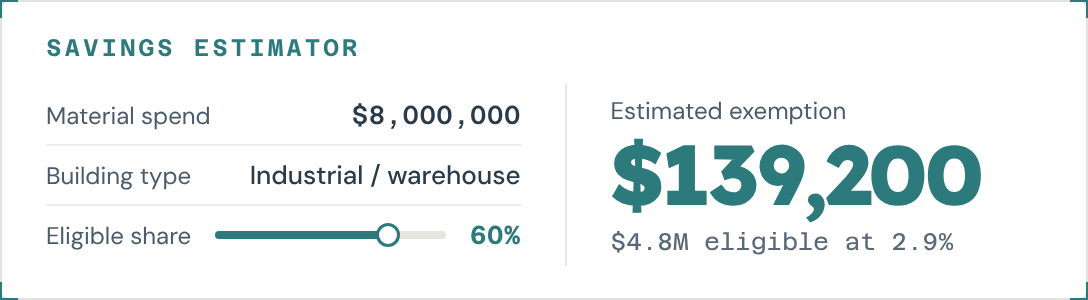
If you’re building in Colorado, the savings estimator will show what your project could save.
02Collect once, submit everywhere
Simplifying the exemption opened a second door. Colorado’s Model Green Code rests on the same Buy Clean Colorado foundation as the sales tax exemption, which means the material data a team gathers for one is the data the other asks for.
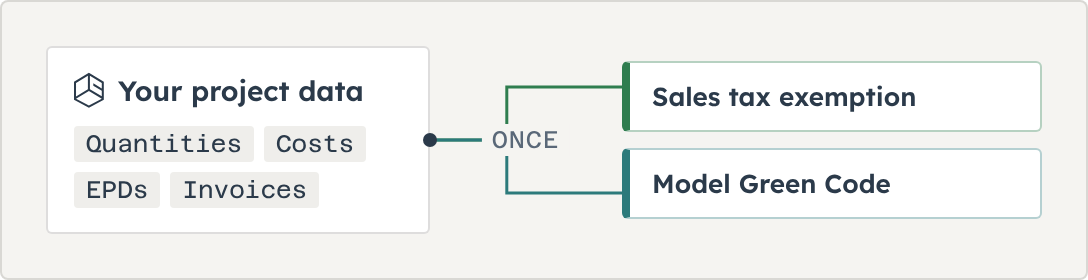
Program Linking puts that overlap to work. A team builds its project record one time, then that record supports the exemption claim and a Model Green Code submittal without a second round of paperwork. As more jurisdictions adopt the code, the same record keeps going further.
Project teams get less duplicate work and lower costs. The state gets something bigger.
Make the incentive easy to use and the code gets easier to adopt.
Colorado projects in design or construction are welcome to enroll.
03An emerging policy template
Colorado’s approach came together in layers, which is what makes it worth studying.
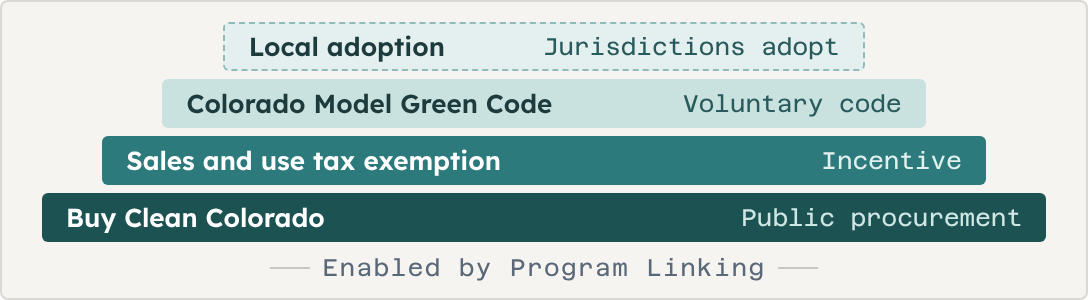
It began with a shared foundation. Under the Buy Clean Colorado Act, the Office of the State Architect set the thresholds and the materials they cover for the state’s own projects. The sales tax exemption took shape alongside it, carrying those same limits into private construction.
The Model Green Code built on both. It is a statewide voluntary code, which the Colorado Energy Office aligned with the incentive. Local jurisdictions can adopt and amend it locally, with the technical groundwork already in place.
The result is a set of policies that reinforce each other through shared data, where cleaner construction costs less to build and less to administer. We think that pattern can travel well beyond Colorado.
If you’re exploring an incentive or code in your jurisdiction, we would love to compare notes.
04For our infrastructure readers
Our work with DOTs is growing quickly, which is why we’re creating dedicated content for transportation teams. If you’d like to receive it, a quick reply will add you to the list.
05Out and about
- 01ECO Platform Summit, November 17–18We’re heading to Brussels as a new member of ECO Platform. Our goal is to expand BuiltCold to make the Energy Performance of Buildings Directive (EPBD) easier to implement across Europe. If you’re attending, we’d love to connect.
- 02Recap: Massachusetts Low-Carbon Concrete WorkshopWe were honored to join the discussion on advancing the Massachusetts low-carbon concrete market, held at MIT in Cambridge. Our thanks to the EFI Foundation for the invitation.
- 03Recap: GreenbuildThank you to the U.S. Green Building Council for inviting us on stage in New York to announce our new partnership. Project data from any public program on BuiltCold can now be submitted for LEED v5. More details to come in our December newsletter.
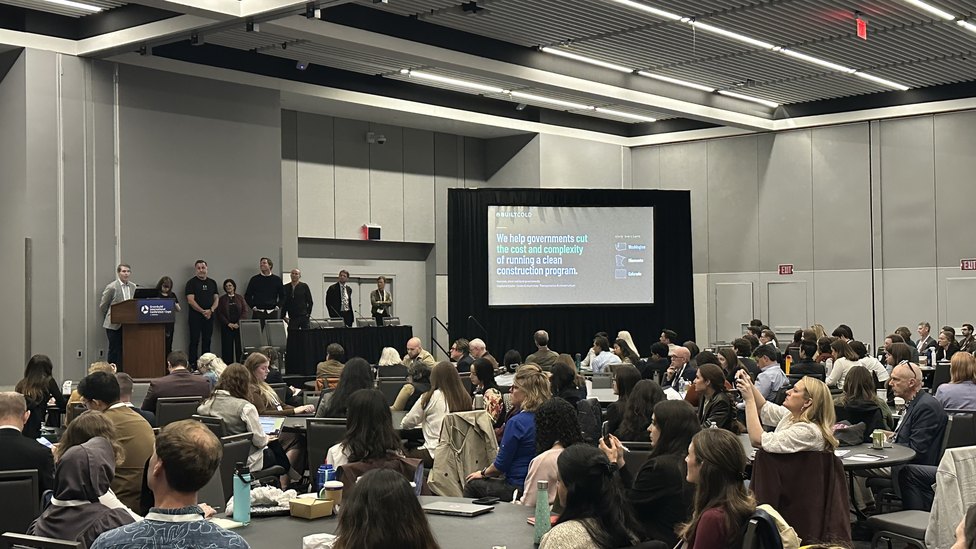
Photo courtesy of Lyndsay Watkins and Wes Sullens, USGBC